Layer Upon Layer
📖 Again, It’s a Painting by Martin Gayford
David Hockney.
Anyone with a bit of cultural interest has probably heard his name (like Andy Warhol). His swimming pool paintings, often used as trendy interior decor, were my image of Hockney. Honestly, I did wonder what was so great about those swimming pool paintings. It was like appreciating Picasso based on a single, childlike scribble. Through Gayford’s book, which compiles years of conversations with Hockney—a man whose eyes always sparkle with curiosity—I finally met a genius old man who is experimental, challenging, and even lovable. How can you not adore this elder who says Van Gogh’s and Cézanne’s works are closer to the world we see than photographs are? If we, like Hockney, see the world in layers, building and observing, building and observing, we might live longer and happier lives.
📝 My Favorite Thoughts and Sentences
pg.7
This book, therefore, is made up of many layers. The word ‘layers’ is one that Hockney is very fond of. He emphasizes the multiple layers that make up a watercolor, the ink films of a print, and the layers of observation over time captured in a portrait.
pg.10
All great artists in the world make the world around us more complex, more interesting, and more mysterious than it appears. This is one of the most important things they do.
pg.24
Do you remember Walt Disney’s Fantasia? In one part of the original version, they used Stravinsky’s The Rite of Spring. But they didn’t understand what Stravinsky’s music was about. They used that music for a scene where dinosaurs were trampling. It suddenly occurred to me that the Disney people had been in Southern California for too long. They had forgotten about Northern Europe and Russia, places where everything bursts through the ground after winter. That’s the power of Stravinsky’s music. It’s not about dinosaurs pushing things over; it’s about nature burgeoning. **
pg.32
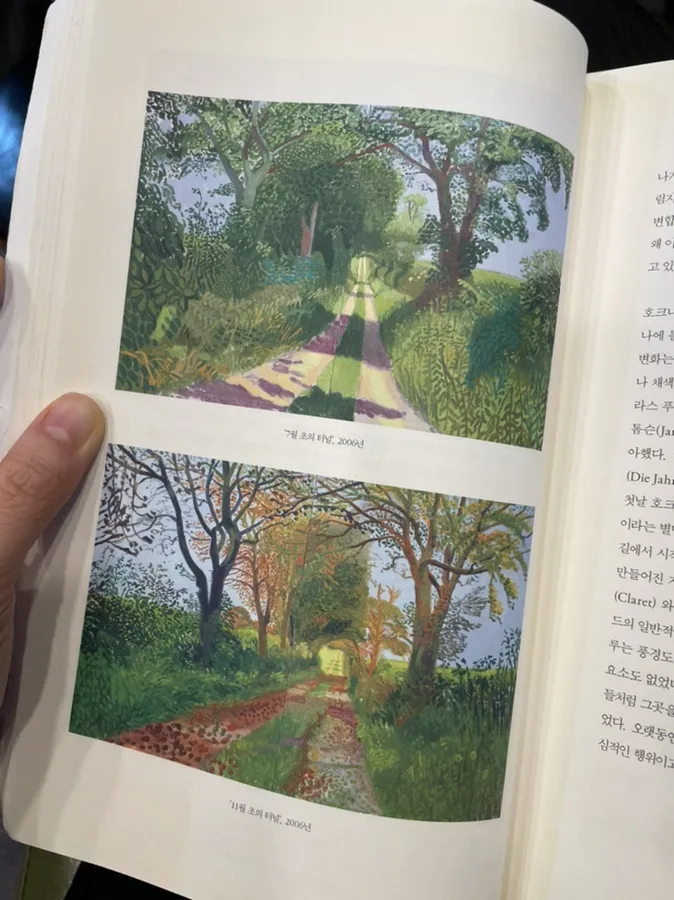
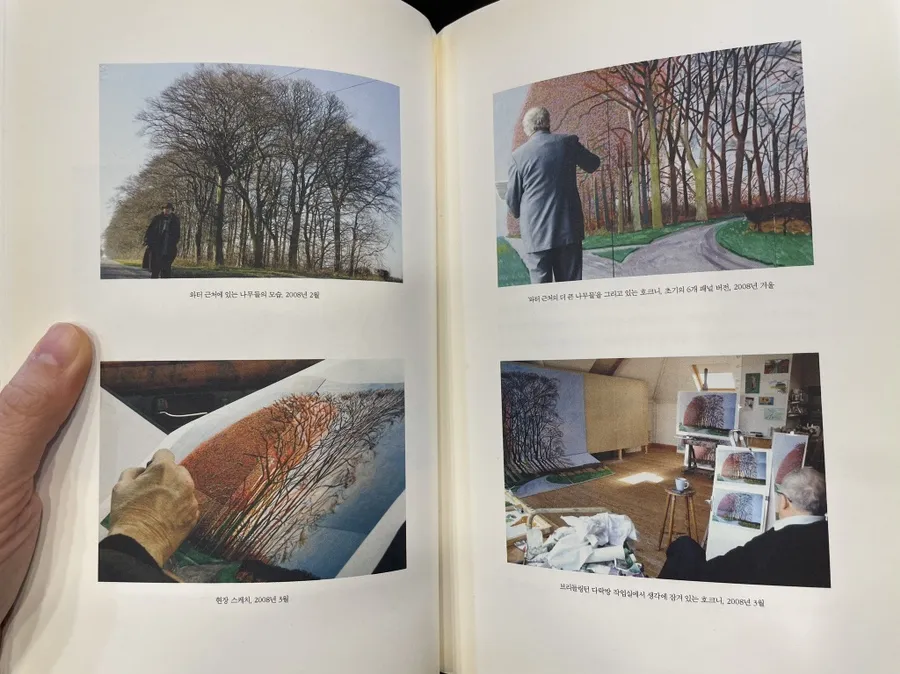
I’ve noticed it here, but it probably takes two or three years to realize that there’s a moment when spring fully ripens. We call it ‘nature’s ballet.’ At that time, all the plants, buds, and flowers seem to stand upright. After that, gravity pulls them downwards. I noticed this in my second year here. And by the third year, you notice even more. When summer is at its peak, trees become masses covered in leaves, and branches bend downwards under their weight. And when the leaves fall, the trees begin to stand straight upwards again. These are things you can notice if you observe carefully. **
pg.47
Most people think the world looks like a photograph. I’ve always thought that while photographs are mostly accurate, they deviate significantly from the world due to the slight differences they miss. That’s exactly what I was looking for.
pg.52
Photographs make us all see in a very dull and similar way. (Omission) ‘Damn it, Pablo Picasso and Henri Matisse made the world look so exciting, but photographs make it look so dull.’ (Omission) We live in an age where an enormous number of images are being created that claim not to be art. Those images are far more dubious. Because they claim to be facts. ** **
pg.70
In other words, photographs cannot show you space in this way. Photographs see only the surface, not space. But space is far more mysterious than the surface. I think the final work will awaken in the viewer a sense of being there.
pg.84
Gayford: One of the basic motivations you keep returning to is the fact that you positively enjoy the act of seeing.
Hockney: Oh, that’s right! I just enjoy it a bit more. **
pg.98
Having limitations is actually a good thing. It acts as a stimulant. If you’re asked to draw a tulip using five lines or 100 lines, you’ll be much more creative when using five lines.
pg.102
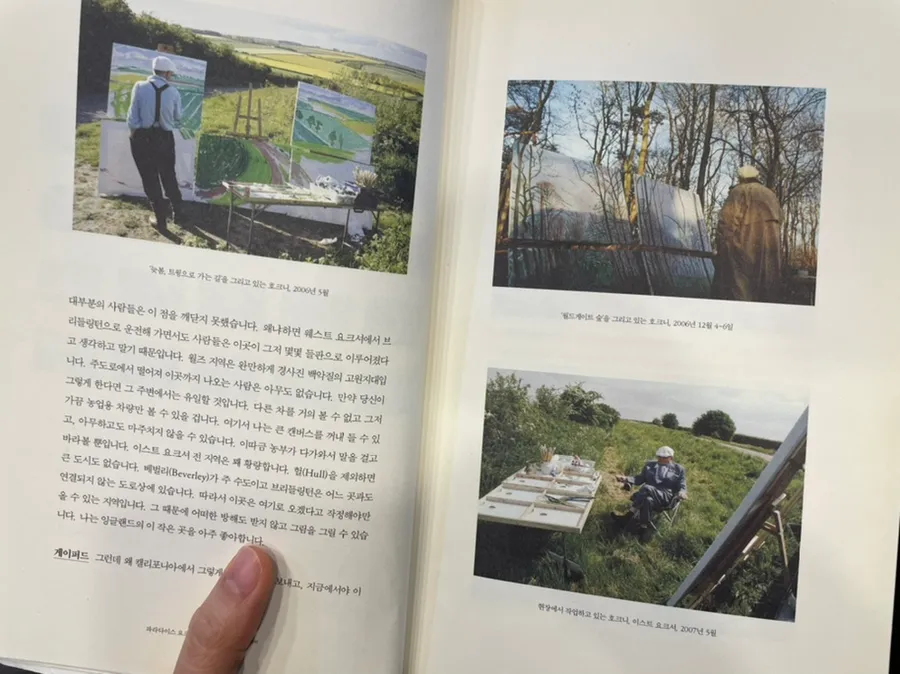
We see with memory. Because my memory is different from yours, even if we stand in the same place, we don’t see the same thing. We each have different memories. Therefore, different factors are at play. Whether you’ve been to a certain place before, how well you know it, and so on, will influence you. Therefore, an objective viewpoint never exists. That is always the case.
pg.109
“Of course, human architects create larger and sometimes very beautiful structures like cathedrals or mosques. But cathedrals or mosques are built; they don’t grow. In contrast, a tree can grow as large as a church, and it is entirely functional from the moment it germinates.” **
pg.115
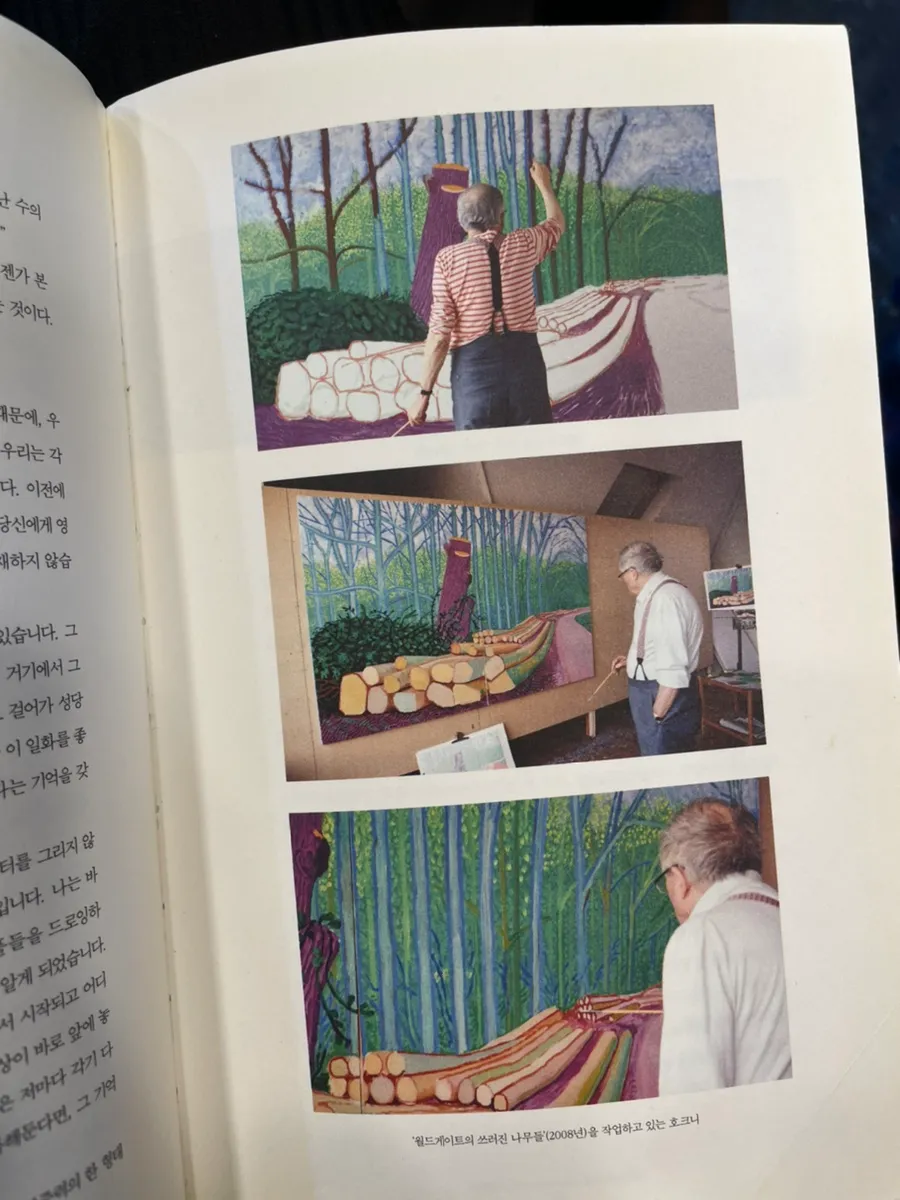
As the conversation continued, I began to understand the core idea Hockney emphasizes through the word ‘layers.’ A painter doesn’t simply apply more and more paint to a canvas or paper. They continuously develop novel ideas and observations, adjusting previous ones through each new thought and observation. It’s essentially similar to the writing process, where one ponders a subject, revising and adding to what was written before. If you think about it, many human experiences are about building layers. Just as we build one layer upon another, we understand the present by comparing it with the past, and then we add more layers, thinking about the present. And accordingly, our perspective changes.
pg.121
But most people don’t. They believe photographs capture reality. Photographs capture a bit of reality, but not that much. Van Gogh knew that. In my opinion, Van Gogh’s and Cézanne’s works are closer to the human perception of the world.
pg.143
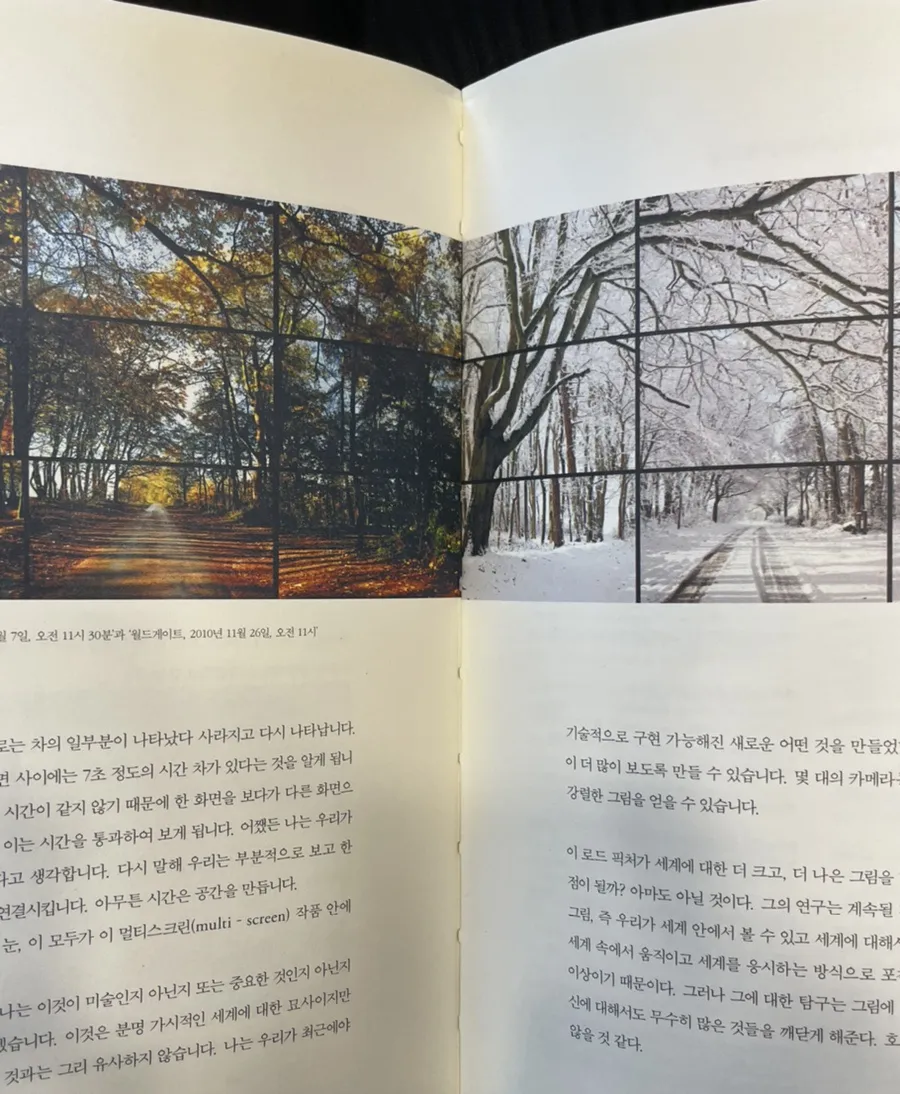
Because photographs see all of it at once, that is, by pressing the shutter once from a single viewpoint. But we don’t. It takes us some time to see it and perceive it as space. **
pg.164
We don’t see that way. We are always scanning and shifting our focus. But for such an image, the camera must be fixed and cannot move much. It’s like someone making a life-sized replica of the world. Where would you put it? The important thing is not to replicate the world, but to interpret it. **
pg.189
Gayford: So, in a way, drawing can be called performance art. But it’s also clearly a way of thinking. When you’re working, don’t you consciously think, ‘How can I translate this into brushstrokes, pencil marks, or pen lines?’
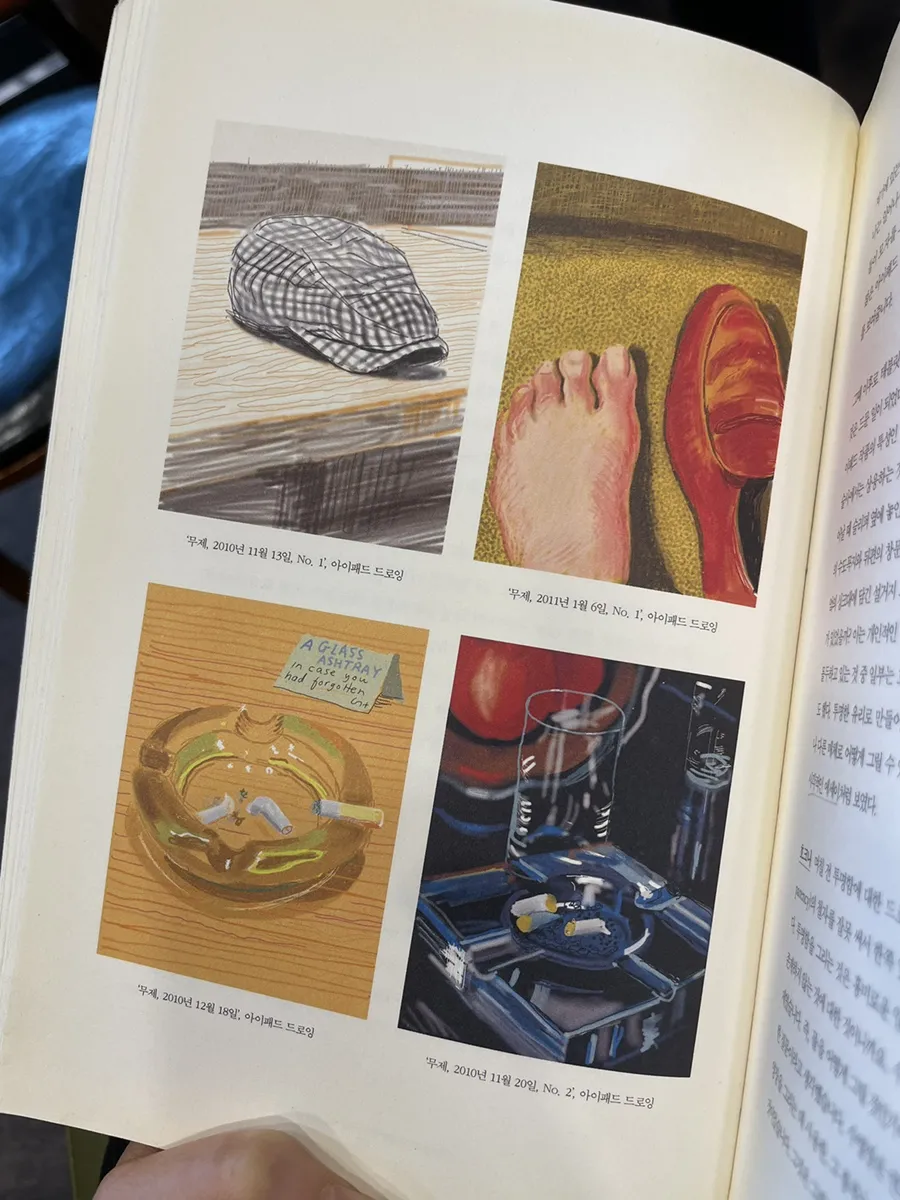
Hockney: That’s right. When drawing, people always think one or two marks ahead. People always think, ‘I’ll draw here, then there, and then there.’ It’s similar to chess. I think economy of means is always the biggest characteristic of drawing. It’s not always the case in painting, but it always is in drawing. The economy shown in the drawings of Rembrandt, Picasso, and Van Gogh is breathtaking. Achieving that is difficult but also interesting. It’s about finding how to implicitly reduce everything you’re seeing into just a few lines, that is, a few lines that include a sense of volume in between them. **
pg.195
Drawing transparency is interesting because it’s about something that visually barely exists. The swimming pool paintings had transparency as their subject. That is, it was about how to draw water. I thought that was an excellent question. Unlike a pond, a swimming pool reflects light. The dancing lines I used to draw the swimming pools were actually about the surface of the water. It was a graphic challenge.
pg.201
Many people consider ideas to be the driving force that changes the human world, while others believe technology or economics play that role. Hockney emphasizes the role of depiction. He argues that people are strongly influenced not only by actual reality but also by its visual representation and interpretation. **