Answering Uncomfortable But Important Questions.
📖 From Employee to Professional_Kim Ho
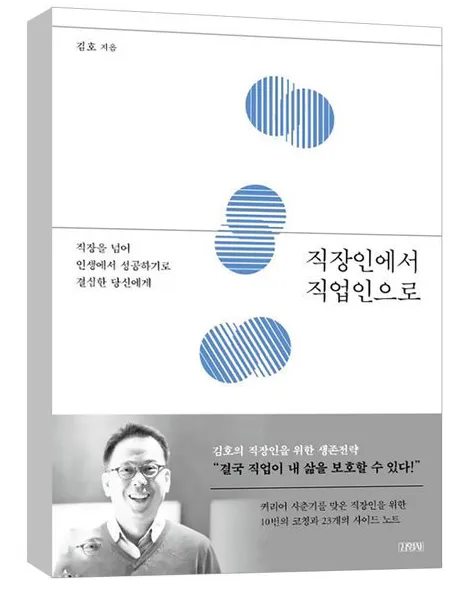
8 years as an employee, all at one company.
I often received job offers, but my conclusion was always,
‘It’s just another job, isn’t it?’
As my tenure grew, my desire to live as a professional, not just an employee, grew.
Just by looking at the book I read during that period and the number of sentences I collected from it,
you can tell the size and weight of my concerns were quite serious.
Since initiative and execution are also indispensable, as a solution to this concern,
since late last year (though there was some stagnation in between),
I’ve been gradually investing time and effort (or rather, despair),
and soon, a streetlamp might light up on the path I’m walking.
If that light turns on, I’ll gladly embark on an exploration with a new perspective,
and if it doesn’t, I’ll just keep walking diligently to find another light.
I give myself generous applause for my attempts and challenges.
📝 My Favorite Thoughts and Sentences
pg.6
“We get jobs based on flawed assumptions, then settle for them. We begin to accept that expecting to live doing what we love is unrealistic.” -Clayton M. Christensen, James Allworth, Karen Dillon
pg.7
Are you an ‘employee’ or a ‘professional’ as you read this book? If you think of someone who works at a company as a professional, or if you misunderstand having a job as simply working at a company, I encourage you to reconsider. A 직장 (place of work) is an organization created by others, but a 직업 (profession) is a personal skill that remains with your body and mind, a skill that can be helpful to someone and exchanged for money (sold).
pg.22
Many employees complain of anxiety and distress due to their careers. If you delve into the root of these feelings, you’ll find that most haven’t properly understood their professional desires or haven’t had the opportunity to think about them. Only when desires are clear can one have a distinct purpose in life and work, and only with a clear purpose can one make decisions aligned with it and live accordingly.
pg.31
Organizations invest various processes and many resources into planning and executing products or services they are responsible for. So why do we not put such effort into our own lives or careers? We write dozens of pages for a new product launch plan, but why don’t we even consider writing a plan for our own lives or careers?
**
pg.46
Microsoft founder Bill Gates has two ‘Think Weeks’ a year, one week each. He intentionally creates time for himself, separating from employees, family, and technology to think about the future or seek new ideas. While not every employee can have two such weeks, couldn’t we all, according to our own circumstances, take a few days, or even just one day, for such intentional alone time?
pg.50
We apply relatively strict standards when spending money, but not when spending time. When buying something, we consider whether it’s worth the money we worked hard to earn. Rich or poor, people try to save money, and they might invest in savings or insurance. We don’t carelessly lend or give money to just anyone. But why time? Money, if lost, can be earned back later. (Omission) However, time is a resource of an entirely different nature. Once spent, it cannot be earned back, nor can it be saved or insured for the future. Everyone is simply given 24 hours. Yet, we often spend the time given to us as others wish, without much thought.
pg.58
Among the things we confront when talking with counseling professionals is vulnerability. Personally, it’s a word I love. Who among us isn’t vulnerable? As Brene Brown, famous for her research on this topic, says, being mentally strong means facing one’s vulnerability, revealing it to someone, and being able to ask for help. A mentally weak person is not someone without vulnerability, but rather someone who tries to hide it or avoids confronting it.
pg.67
There was an impressive postcard I received every year-end. My American business partner used to send a postcard ranking his top 10 memories from the year. Inspired by that postcard, I also started ‘10 Memories to Cherish from the Year’ in 2014. I bought a small 33cm x 24cm canvas at a stationery store, divided it into 10 sections, and recorded the year’s events with words and drawings. Even now, at the end of the year, my wife and I look back and choose our top 10 “news” from the past year.
pg.103
He says that his current activities are possible because he had his own motive—picture books. He advises having a space to accumulate one’s own thoughts, not a space to show others like Facebook. He accumulated his thoughts by reading books, visiting exhibitions, and writing posts on his blog in his spare time.
There’s a saying that everyone is an expert in some field. Everyone has their own unique expertise. However, those who discover it live as professionals, while those who don’t live precariously in jobs created by others.
The future offers opportunities and happiness more to those who ponder what they truly love and can immerse themselves in, rather than those who worry about what will be promising.
pg.117
By imagining our own death and looking back from that perspective, we examine life from a different angle. We see the balance between the many things that happen at work and the time spent with family from a different angle, and we re-examine the things we must do and the things we want to do. Questions like ‘How will I live?’—just like ‘How will I die?’—are ‘uncomfortable’ questions that require deep thought and consideration. That’s why we keep postponing these uncomfortable questions. But to live life properly, we must eventually pull out a map and check our position. Looking at the map means answering the uncomfortable but important questions in our lives.
pg.146
What exactly are my marketable personal skills? For this, I propose the ‘Soomgo.Kmong Test.’ Soomgo and Kmong are services that connect freelancers who register their marketable skills with people who need those skills.
The Soomgo.Kmong Test is about figuring out what your personal skills are and how you would express them if you were to register them on such a professional site. It’s also good to think about your own marketable skills regardless of the categories provided by the site. This isn’t about becoming a freelancer immediately or registering yourself on these sites. You can get ideas for finding your personal skills by looking at such sites. A similar English-speaking site is freelancer.com.
pg.184
Rather, it means that it’s difficult to prepare for a new future simply by always obeying your boss. If current employees in their 20s and 30s spend the next 10 years as obedient employees within the past paradigm dominated by those in their 40s and 50s, they might get some promotions, but they should consider that it could be difficult for them to develop their own competitiveness after 10 years.
What does ‘conscious disobedience,’ as Ito described it, mean for employees? First, let’s consider that the world and the equation for success presented by our workplace are not everything. Instead, let’s step outside the workplace, interact with people living different lives, and observe what future is approaching. It’s about developing your own ability to think, rather than being solely absorbed in the information and interpretations provided by the company.
Education is what schools or companies make you do, but learning is what you do yourself. Do you have your own learning channels, methods, and interpretations? Your boss might influence your promotion and salary, but they are not responsible for your survival. Let’s reflect today on whether we are spending our lives simply going to work, uncritically accepting our boss’s instructions, and processing them.
pg.187
Surprisingly, by making rejection his goal, CEO Jang was gradually able to overcome his fear of knocking on doors and being rejected at offices he had never seen before. The foundation for him, despite not being fluent in English, to conduct business worldwide is his complete lack of fear of rejection.
We consider success as the default and rejection as an exception, which is why we don’t attempt things that seem likely to fail. Jia Jiang, in his daily attempts to achieve 100 rejections, was surprisingly met with many people who readily agreed instead of rejecting him, to his bewilderment. When approaching work with rejection as the default, you encounter unexpected opportunities. For successful people, rejection is not an exception but the default. If you fear rejection, you cannot grow.
pg.245
What is networking? If you think it’s about having drinks with colleagues several times a week, let’s reconsider. Networking is about having meaningful conversations (not just superficial pleasantries) with people in weak ties, sharing information and thoughts even just once a year. When you think about how good information or ideas can come to you through networking, you’ll recall the law of reciprocity. If you want others to give you good information or ideas, you should give them to others first when you have them. Just as investment is needed to gain profit, in relationships, if you first show trust and offer help, it will eventually come back to you, directly or indirectly.
pg.277
In the process of transforming from an employee to a professional, one’s current lifestyle might feel like a barrier, but it’s necessary to honestly confront oneself and consider whether it’s being used as an ‘excuse.’ An employee I met during the book-writing process showed considerable responsibility. He displayed immense responsibility towards his team members and juniors at work, and also significant responsibility towards the person he lived with. However, it seemed he wasn’t taking care of himself, so I asked him about this, and he replied that he hadn’t thought about it that way.
Whichever way it goes, each person makes their own choices. However, I urge you to consider whether you are closing one eye and thinking your current state is the best, or if you are using your lifestyle as a shield of excuses rather than trying to change it.
pg.313
By your mid-30s, you need to decide whether you want to make your mark at the company or leave to pursue something of your own. Accordingly, you need to set a career vision. By your mid-30s, you would have worked for approximately 10 years, and you should be able to make your own judgment about what path you should take going forward.
Listening to CEO Yu’s story for over an hour that day, what stuck with me the most was the phrase, “Outside the company is not hell.” He said there are plenty of ways to live even after leaving a company, but he urged two things: if you leave the company and live with irregular income, you must be able to reduce your spending more than when you were in an organization, and you must build your own competitiveness while still within the organization before leaving.
pg.315
When he said, “Unlike when I was an employee, the good thing about running a used bookstore is that I don’t have to live a lie,” I honestly flinched. It felt as if my own experiences of exaggerating or lying to customers or bosses to make a good impression during my corporate life had been exposed.
They all chose to reduce the importance of money in their lives to gain the freedom to spend time on what they love. The commonality is that all of them are currently living satisfying lives.
pg.321
As I encountered the stories of these three people, I thought of them as ‘people who open up a new future by living in the present.’ In many cases, people sacrifice the present for the future. They think that doing what they want can wait until later. These three people didn’t ask, ‘What will be a stable job in the future?’ but rather, ‘What do I want to do right now?’ And then they embarked on an adventure. No one knows what the outcome of this adventure will be, just as no one knows what the outcome of most employees’ careers will be.
pg.326
His book, <How Will You Measure Your Life?>, also quoted in this book, is one I’ve reread repeatedly at the end of each year since I first read it in 2012. He says that if you want to know where your life is headed, you should look at where you are currently allocating your given resources—time, money, and energy—rather than examining your future plans. In other words, it’s a matter of resource allocation. Many employees cut down on sleep and dedicate most of their waking hours to work, without ever examining what their professional desires truly are.